
Filtering tools for Alarm Dashboard
You can search for Alarm Dashboard records by applying the various filter icon.
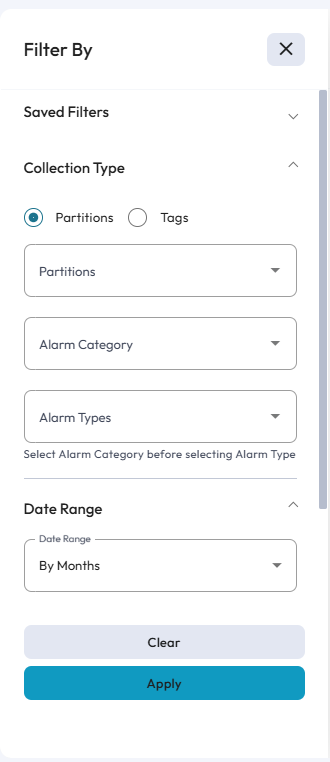
For more information about the filters options, see the following table:
| Filter options | Description |
|---|---|
| Saved Filters | Displays the list of filters you have saved for your reference. |
| Collection Type | Allow you to filter results using either Partitions or
Tags.
|
| Date Range | Allow you to define a date range to further narrow down the search
based on Days/Weeks/Months/Hours/Custom (depends on the license). It gives an aggregate report of the alarm activities that helps you to monitor and manage alarms within the environment. |
| Save Filter Preset | Use this option to save applied filters. You can save multiple filters for your
reference and also delete them when not required. If you save a filter with specific values and log out the application, then logging on again to the application and navigating to the Alarm Dashboard, lands you to the last saved filter data. This option is specific to the individual operator. When one operator creates a filter, it is not accessible to other operators. |
| Apply | Apply the filter based on the selected values and fetch the alarm data. |
| Clear | Clears all selected filter values and displays the default page view. |
- Total alarm activations
- Alarm category and type
- Top locations
- Top N alarms by location
- Alarms by date range
- Top N partitions with highest alarms
- Top N alarm types
| Alarm Category | Alarm Types |
|---|---|
| Input | Activate |
| Input | Armed |
| Input | Disarmed |
| iSTAR Cluster | Offline |
| iSTAR Cluster | Online |
| iSTAR Controller | Offline |
| iSTAR Controller | Online |
| Door | Admit |
| Door | Reject |
| Door | Forced |
| Door | HelpOpen |
| Door | Open |
| Door | Closed |
Following are some scenarios where you can see alarm automation status in a particular format:
Scenario 1: By Months
When you select Date Range as months, the system shows weekly basis data for one to two months of range. For more than two months, system displays monthly data.
You can view the data of up to 14 months (based on the license).
Scenario 2: By Weeks
When you select the Date Range as week, the system shows daily basis data for one week. For more than a week, system displays weekly data.
You can view the data of up to 4 weeks.
Scenario 3: By Days
When you select the Date Range as days, the system displays hourly data for a single day. For more than a day, system displays daily basis data.
You can view the data of up to 30 days.
Scenario 4: By Hours
When you select the Date Range as hours, the system shows the data on hourly basis.
You can view the data of up to 24 hours.
Scenario 5: Custom
When you select the Date Range as custom from the drop down menu, the system allows you to set the Start Date and End Date to view the customize data.